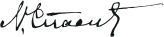
Anastasija Naka Spasić was a benefactress, humanitarian, initiator, inspiration and participant in most of the important relief initiatives in Serbia in the first half of the 20th century. In her lifetime she never created humanitarian funds, fearing they would be nationalised; she gave the people only what she herself possessed.
She was the eldest child of Stevan Lujanović, merchant, savings-bank director and honorary consul of the Kingdom of Serbia. Her mother was Jelisaveta Veta Lazarević, born in Negotin, who moved to Orșova to live with her aunt Anastasija Teodor, married to the Greek merchant Giorgios Teodor.
The Lujanović family was very wealthy. They first lived in Vršac, then fled to Orșova after Hungarian neighbours threatened to kill them all if they stayed.
Anastasija Spasić was born on 31 December 1864 in Orșova, a town now in Romania. She received the nickname Naka in early childhood.
She was educated at home, because she would not attend the Hungarian primary school then compulsory on the territory of the Austrian Empire.
Her parents provided several tutors and fully supported her wish to learn at home and to take her first letters in her mother tongue, Serbian. At home she received a broad education and, besides Serbian, learned to speak Romanian, German, French and English fluently.
At twenty, against her family’s wishes, she married Adolf Hartmann, a captain of the Danube navigation from Vienna. She spent summers in Drobeta-Turnu Severin and winters in Vienna. The marriage lasted ten years and they had no children. Her husband died of pneumonia.
After his death Anastasija went to Chicago, where her uncle Mihailo Lazarević, merchant and banker, lived. Also in the United States was her youngest brother Milan, an able and educated man in forwarding, agent of the Leipzig Fair for the Balkans. Around 1900 Anastasija returned with her brother to Orșova to live with their parents, where she met Nikola Spasić, the Serbian merchant, benefactor and founder of endowments, who in time asked for her hand. They were married in Belgrade, in the Cathedral Church.
Nikola Spasić, like Anastasija, was a widower already deep in humanitarian work. Besides that work the Spasićs began growing native and exotic plants; in the family house at Kneza Mihailova 33 they had a garden with a lemon tree, mandarins, rare canes and palms. On Topčider Hill, today part of Dedinje, Anastasija laid out a park of rare plants around the summer house, part of which still exists.
With her husband she lived at Kneza Mihaila 33.
Beside her husband, long engaged in humanitarian work, Anastasija developed her own under the influence of Nikola and of her nearest neighbour and friend Draga Ljočić.
Besides many gifts, Nikola Spasić, at Anastasija’s urging, leased the Monopoly Administration building — today’s Faculty of Philology on Kneza Mihailova — and turned it into a hospital. Besides the doctors, Draga Ljočić and Anastasija Spasić worked there as chief nurse, with her nephews Marija Mata Popović and Nikola Terzić.
All food for the wounded and sick was prepared in Anastasija Spasić’s kitchen; for this she was awarded the Cross of Mercy of the Kingdom of Serbia.
After the war and the restoration of peace in Serbia, Anastasija gave all the hospital material and medicines to the Red Cross.
Not long after, at the beginning of the First World War, when she had already given all necessary help to the wounded, Nikola Spasić, in agreement with Anastasija, handed their home at Kneza Mihaila 33 to the Serbian National Invalids’ Fund Saint George.
Nikola Spasić died on Corfu in 1916; Anastasija and her brother Milan Lujanović brought his remains to Belgrade.
After her husband’s death she devoted herself still more to humanitarian work. She was a member of almost every Serbian humanitarian organisation, in many of them on the board, vice-president or president. At the same time she was president of the Society “Princess Ljubica”, of the Home for Secondary-School Girls, of the Invalids’ Home Saint George, of the Nikola Spasić Endowment and of the Society Daily Bread, and a board member of the Red Cross, the Circle of Serbian Sisters, the Society “King Dečanski” and many others.
Little evidence of her humanitarian work in the First World War survives, because she did not deposit her papers in archives, and many documents were burned so that they would not fall into the hands of an enemy army that persecuted and killed national workers.
Besides her labour she helped many societies financially. She gave large sums to the Serbian Orthodox Church, especially churches in southern Serbia and Kosovo and Metohija.
Nikola Spasić’s great friend Đorđe Vajfert, industrialist and governor of the National Bank, gave land to the Society of Belgrade Women Doctors, where a hospital for women and children was built with the help of women doctors from Scotland and of Anastasija Spasić. Today a plaque on a building of the Dr Dragiša Mišović Clinical Centre still names the greatest donors, among them Anastasija Spasić.
Work in so many societies took much of her time, especially the Society “Princess Ljubica”, of which she was president and whose seat was in Štimlje in Kosovo. Journeys to Štimlje became ever more frequent; there, with the other members, she helped children without parents. On one journey toward Štimlje she was injured and suffered a cracked hip; she recovered and continued her humanitarian work.
After the founding of the Society “Daily Bread” in Belgrade in 1927, which provided the poorest with one loaf a day, she joined that society and greatly strengthened it, securing large financial help.
After the beginning of the Second World War, General Milan Nedić came in person to her home and offered her the presidency of the united women’s humanitarian societies he wished to found; she refused, saying she was old, but that she would not rest from humanitarian work, especially in wartime.
During the Second World War she suffered many tragedies. In the bombing of Belgrade on 16 April 1944 her niece Desa Janković and four children were killed at Francuska 11, and a little later her nephew Mata Popović during the Belgrade Operation. Even so she had the strength to continue her humanitarian work after the loss of those dear to her.
After the Versailles Treaty the League of Nations was founded; she was elected vice-president of its society, and from 1937 was its president.
After 1944 she was appointed president of the Union for the Protection of Children of Serbia, a post she held until 1947, when the society was banned.
Anastasija Naka Spasić died on 13 October 1953 in Belgrade. She is buried at Topčider Cemetery in the Church of Saint Tryphon.
A street on Dedinje still bears the name of Naka Spasić.
(Source: Wikipedia)