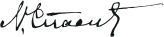
Nikola Spasić, a great national benefactor, was born on 2 November 1838 in Belgrade.
At the beginning of the 19th century, fleeing Ottoman rule, many families from the south set out toward the border of free Serbia. The Ottomans tried to stop these migrations, so the families travelled for a very long time, stopping in villages and towns along the way. That was the case with Nikola Spasić’s grandfather Stojan and his family, whose journey to Belgrade lasted almost two years. On that road, in Leskovac, Nikola’s father Spasa Stojanović was born. At that time it was customary for sons to take a surname from their father’s given name. Nikola’s grandfather Stojan and his family reached liberated Belgrade around 1807.
Spasić’s grandfather put all three sons to a trade. Nikola’s father Spasa began learning the aba-tailor’s craft as an eleven-year-old boy and in 1826 opened an aba shop. He married Magdalena, a countrywoman from Old Serbia, who died when Nikola was only four. Spasa married a second time, to Petrija, with whom he had four sons and three daughters; after Petrija’s death he married the widow Jelena, with whom he had one son and two daughters.
Nikola Spasić finished the first year of gymnasium, but because of the family’s poor circumstances he first learned the trade with his father. From his father’s shop he moved to his uncle Tasa Stojanović, a grocer on the Sava, then to the leather workshop of Radovan Barlovac, which had strong ties with Serbian towns in the interior.
After fifteen years at the trade, Nikola opened his own leather shop, “Nikola S. Spasić”, in Vasina Street (1865), later moving it to Kneza Mihailova Street. The starting capital was 200 ducats, which was not enough, so for the first and only time in his life he borrowed 500 ducats from Đoka Jovanović, the brother of his first wife Leposava. Nikola kept a lifelong gratitude toward Đoka Jovanović. When Đoka later lost everything, Nikola supported him until his death.
The leather trade was then very good. Not only Serbian villagers but also townspeople, Serb and Ottoman, wore opanci. Nikola made the opanci himself and ran the shop with the great help of his wife Leposava, who was equally hardworking and modest. Short of space, he dried the opanci in the small room behind the shop where he and Leposava slept, keeping the stove going at night all year — even in summer — enduring the heat and the smell of leather.
From the start, the shop knew the cost of labour, materials and overheads, and the opanci were sold at a price only one groschen above the total cost of making them. Haggling was out of the question. Because of the quality and the fair price, sales kept rising.
Alongside the opanak craft, Nikola developed a trade in dressed leather and linen. He sold linen by the rif (77.8 cm) as he sold opanci, always at a fixed price, earning one groschen per rif. He bought linen in the villages from the peasant women who wove it. A crier would announce the day of his coming, and Nikola Spasić would arrive with a horse-drawn cart, buy thousands of rifs of linen and load them at once. On those journeys the coachman was paid a meal and wine at the inn; Nikola Spasić drank only water and ate food he had brought with him. He treated every customer alike; when he brought goods he would count the customers, add up the rifs they asked for, and if he had not enough linen he divided it in proportion to their requests.
In his business Nikola paid cash for all material for opanci, for linen and for everything he bought, thus gaining 2–3% “cash discount”. He held that credit should be given to everyone or to no one. At first he did not sell on credit; later he began to give goods to merchants on credit, but always in smaller quantities. Losses on loans he blamed on himself for having made them, not on those who borrowed. He never went to law. He disliked easy money. He never bought lottery tickets. He believed that if he won, the money would not be his but someone else’s: “Another man’s money is fire in my straw. What do I want with that?” He preferred to keep money longer in the bank on deposit than to enter uncertain “shareholding adventures”.
Even during the Serbo-Ottoman wars (1876–1878) Nikola Spasić’s shop did not stop. In the First Serbo-Ottoman War he served as a cavalry private; in the Second, for the first and only time in his life, he worked with the state and delivered 25,000 pairs of opanci for the army. Nikola Spasić did not trade with foreign countries.
His motto was: “Work and save, save and work.” He often told the young: “You need not spend all you earn today. Set something aside for hard times — no one knows what day or night may bring.”
Wishing to lead and control his ever-widening affairs himself, he worked all day, and with innate thrift and a very modest way of life, dinar by dinar, he acquired great wealth. When a friend asked, “Where does all that money come from?” Nikola answered: “You see, brother, that I work — I work all the time. Can a man be without money when he works?”
He was respected not only as a rich merchant but as an honest and wise man. His opinion on many questions was sought and valued.
He most liked to be in his own house and rarely went to taverns. Though personally very modest, he was a great aesthete, as may be seen from the buildings he raised and bequeathed, which are handsome inside and out. In those days decorating buildings in Belgrade was thought an unnecessary luxury.
Nikola Spasić retired from business in 1899.
He married three times. First, in 1864, to Leposava, sister of Đoka Jovanović, a trustee of Miša Anastasijević, just before opening his first shop. After six years Leposava died childless. Second, in 1873, to Stanka-Caja, daughter of Lazar Milojković, an aba-tailor from Belgrade, who died in 1903, also childless. Third, in 1907, to Anastasija-Naka, daughter of honorary consul Lujanović in Orșova.
Nikola first built a house in Dobračina Street, which he soon sold, and bought a plot at Kneza Mihailova 33. There he raised a ground floor and two storeys in 1889.
A little later he bought a house — ground floor and one storey — at the corner of Kneza Mihailova and Vuka Karadžića and added another storey.
In 1910 he bought another house at Kneza Mihaila 19. It then had only a ground floor and one storey on Kneza Mihailova and a large courtyard opening onto Obilićev venac 17. Over this whole complex, in 1913, Nikola raised a new building facing two streets, of a ground floor, two storeys and a large passage — the first of its kind in Belgrade.
Spasić’s shop stood opposite the “Sloga” building, and from the start of his work he wished to buy that property. The estate and building had belonged to Prince Aleksandar Karađorđević. After the Prince’s exile the state confiscated it and later sold it to the “Sloga” joint-stock company, from which the building took its name. In it was the Belgrade Casino, where the finest Belgrade society gathered, with entertainments and lectures. Just before the Balkan War Nikola bought the estate and so fulfilled a long-held dream.
The Board of his Endowment demolished the old “Sloga” building and in 1930 raised a magnificent palace facing three streets: Kneza Mihailova, Kralja Petra and Nikole Spasića.
In his lifetime Nikola Spasić already set aside large sums to help the Serbian people.
He built the Church of St. Great Martyr Tryphon at Topčider Cemetery (1903), the Pupils’ Shelter (1908) in the courtyard of the Palilula primary school in Belgrade, and paid all the costs of its upkeep and of housing poor pupils.
In the premises of the Monopoly Administration (1912) he opened a hospital for 50 wounded. At his own expense he provided beds, bedding, medicines and all the material a well-ordered hospital should have. Food for the wounded was prepared in his own house under the supervision of his wife Naka, who was also the chief nurse. He helped many of the wounded financially as well. When the last wounded man left Spasić’s hospital, Nikola gave all the hospital furniture and medical material to the Serbian Red Cross. For her work in the hospital Anastasija-Naka was awarded the Cross of Mercy.
The first church bell that went from free Serbia to the South was sent by ox-cart by Nikola Spasić to Prizren. Milka Vulović, pretending to be ill, lay on the bell hidden in straw so that the Ottomans would not find it. Not only to Prizren but to other places Nikola Spasić sent church bells, considerable sums of money, liturgical books, chalices, crosses, vestments and many other things.
In the 1890s Nikola Spasić also bought up part of Serbia’s foreign debt, which may be counted among the first donations for Serbia’s development.
He bequeathed all his property — the immovable estates at Kneza Mihaila 19 and Obilićev venac 17, Kneza Mihaila 33 and Đure Jakšića 1, and the “Sloga” building, which the Board later demolished and replaced with a new one at Kneza Mihaila 47, Nikole Spasića 2 and 2a and Kralja Petra 18 — cash, shares and bonds, to the Serbian people by his holograph will of 9 February 1912, by which he founded the Nikola Spasić Endowment. The value of the endowment’s property at that time is considered to have been comparable to that of the Nobel Foundation.
By that will he left his wife Anastasija-Naka the summer house and vineyard on Topčider Hill in ownership, a widow’s enjoyment, lifelong free use of the apartment in which they lived, and the right to use three further apartments in the family house at Kneza Mihaila 33 — all of these rights only until any remarriage. To his relatives he left negligibly small sums.
His last wife Naka is thought to have most influenced Nikola Spasić to found the endowment, which makes her words unsurprising when friends and lawyers advised her to claim her legal share in court and contest the will: “Spasić’s wish is law for the whole world — how could it not be for his widow?”
By edict of King Alexander I the work of the Nikola Spasić Endowment was approved: “We, Alexander I, by the grace of God and the will of the people, King of the Serbs, Croats and Slovenes, on the proposal of Our Minister of Education in agreement with the State Council and on the basis of Art. 3 of the Law on Endowments, approve: That an endowment be founded under the name: ‘Nikola Spasić Endowment for the building of hospitals and a home for poor infirm Serbian citizens and for general economic aims’. Our Minister of Education shall execute this edict. 4 December 1922, Belgrade. Signature of King Alexander and of the Minister of Education.”
In his later years, because of the war, Nikola Spasić withdrew from Belgrade into exile with his wife. In Kruševac on 24 August 1915, admiring the national resistance of the people and the heroic glory of the army, he founded the endowment “Home of the Serbian National Invalids’ Fund Saint George — Nikola Spasić Endowment”, giving his immovable property and the building at Kneza Mihaila 37 and Vuka Karadžića 8. He thereby altered clause 7 of the 1912 will, by which he had left that building to his nephew Nikola S. Spasić.
By edict of the Heir to the Throne, King Alexander I, the work of the endowment was approved: “In the name of His Majesty Peter I, by the grace of God and the will of the people, King of Serbia, We, Alexander, Heir to the Throne, on the proposal of Our Minister of Education and Ecclesiastical Affairs, in agreement with the State Council and on the basis of Art. 3 of the Law on Endowments, approve: That an endowment be founded under the name ‘Home of the Serbian Invalids’ Fund Saint George — Nikola Spasić Endowment.’ Our Minister of Education shall execute this edict. 14 September 1915, Niš. Signature of Heir King Alexander and of the Minister of Education and Ecclesiastical Affairs, Ljub. M. Davidović.”
Continuing the road of exile, Nikola Spasić and his wife left the homeland and reached Greece; when revolution broke out in Greece against King Constantine, they went from Piraeus to Corfu. After only three days on Corfu he died on 28 November 1916. He was buried temporarily on Corfu and, as soon as circumstances allowed, in April 1923, was brought to Belgrade and solemnly buried at Topčider Cemetery, in the Church of St. Great Martyr Tryphon, which he had built in his lifetime as his endowment.
From 1896 until his death Nikola Spasić was a member of the Board of the National Bank. From 1899 until his death he was chairman of the Board of Prometna Bank, and from 1913 chairman of the Insurance Company of Serbia. For a long time he was a municipal councillor, a deputy for the City of Belgrade, and president of the humanitarian society “King Dečanski”.
He was awarded the Takovo Cross, 4th class, and the Order of Saint Sava, 3rd class.
Bibliography:
- Memorial of Nikola Spasić, Nikola Spasić Endowment, Belgrade 1931.
- Economic Chronicle of the Nikola Spasić Endowment, vol. 1, Nikola Spasić Endowment, Belgrade 1936.
- Economic Chronicle of the Nikola Spasić Endowment, vol. 2, Nikola Spasić Endowment, Belgrade 1937.
- Economic Chronicle of the Nikola Spasić Endowment, vol. 3, Nikola Spasić Endowment, Belgrade 1938.
- Sofronijević, Mira: They Gave to Their Fatherland, Belgrade 1995.
Portraits of Nikola Spasić
The Endowment holds two portraits of him.
The bust portrait of Nikola Spasić, oil on canvas, 78 × 66 cm, is the work of the distinguished Serbian painter of academic realism Uroš Predić (1857–1953), marked by the author’s monogram — UP 1926 — in the lower left corner.
The life-size portrait of Nikola Spasić, oil on canvas, 210 × 114 cm, is likewise the work of Uroš Predić (1857–1953), marked by the monogram — UP 1936 — in the lower right corner.
The painting has a decorative frame 16 cm wide with carved ornament, reliefs of scenes and saints (St. Sava and St. Tryphon), by Nestor Aleksijevski (1877–1969), of undoubted applied-art value.
The paintings and the frame have the character of cultural property.